

Friday 22 July 2016
Join YesCymru - The Campaign for Welsh Independence
Join YesCymru to be part of the only organisation that is actively campaigning for Welsh independence. Full details at: yes.cymru/join/

Thursday 2 April 2015
Home Rule Rally, Cardiff, 04/04/15
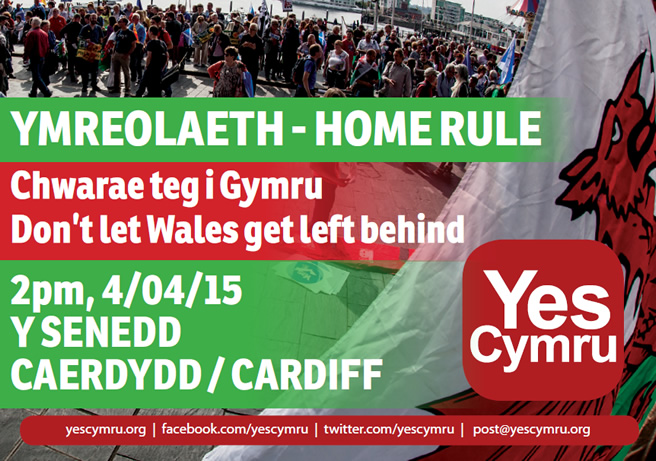
HOME RULE – Don’t let Wales get left behind
2pm, April 4, 2015, Senedd, Building, Cardiff
Contributors:
Adam Price – Former MP
Dewi ‘Pws’ Morris – Musician, actor and comedian
Catrin Dafydd – Author and campaigner
David Petersen – Sculptor and leader of the St David’s Day Parade
Jamie Bevan – Campaigner and Chair of Cymdeithas yr iaith
Iestyn ap Rhobert – Yes Cymru
Sunday 17 August 2014
Wales Supporting YES - Cymru’n Cefnogi IE

- Facebook Page: facebook.com/GoForItScotland
- Facebook Event: facebook.com/events/1490201901225604
- Twitter Page: twitter.com/walesyes
- Email: walesyes@gmail.com
- Poster: PDF
Wales Supporting YES
Supporting Scottish Independence
2pm, Saturday September 13th
Senedd Building, Cardiff Bay
Less than a week before the historical vote in Scotland, come to the Welsh capital to wish the people of Scotland well in their quest for self-determination.
===================================
Cymru’n Cefnogi IE
Cefnogi Annibyniaeth i'r Alban
2pm, Dydd Sadwrn Medi 13eg
Y Senedd, Bae Caerdydd
Llai nag wythnos cyn y bleidlais hanesyddol yn yr Alban, dewch i brif ddinas Cymru i ddangos eich cefnogaeth i bobl yr Alban yn eu hymgais dros annibyniaeth.
Friday 20 June 2014
Tuesday 31 July 2012
What price Independence? - Mabon ap Gwynfor
 |
| Mabon ap Gwynfor |
Indeed if you are sad enough to read the comments section of papers like the Mail and Express (like i occasionally find myself doing!) you’ll see that it seems to be a commonly held belief that England subsidises everything in Wales. Dr Eurfyl ap Gwilym countered this argument brilliantly in his never to be forgotten tête-à-tête with Paxman on Newsnight.
However there are many within the Welsh national movement, many good friends of mine, who continue to argue that we cannot contemplate independence until we resolve what is called the ‘funding gap’, that is the gap between our income and expenditure.
Furthermore we are constantly told, by people in my own party as well as others, that Wales has become poorer over the years with our GDP falling
I am very uncomfortable with these arguments. Firstly the funding gap.
Do we seriously believe that Tom Clarke, Sean McDermott, Patrick Pearse, Joseph Plunkett, James Connolly and other leaders of the Easter Rising in Ireland discussed the planning of the Easter Rising then said “Hold on, how do we resolve the funding gap? Let’s wait a generation”, or more relevant maybe what if Vaclav Havel and the student movement in the then Czechoslovakia decided to hold off the velvet revolution for a generation because of the ‘funding gap’?
They didn’t because there was a fundamental principle at play, that of the right to self-determination (Copyright David Cameron vis-à-vis The Malvinas/Falkland Islands).
And in any case, what about the funding gap? It is said to be somewhere in theregion of £6bn in Wales.
Firstly the simple way to resolve any funding gap is to increase income or lessen expenditure…or both. There is no doubt that an Independent Wales’ expenditure would be significantly less than our current proportion of UK expenditure. We wouldn’t have Trident for one thing. It is likely that our military spend would be significantly less overall. We wouldn’t be subsidising London either. Neither would we have to pay back for enormously expensive English PFI projects. Looking at the political make-up of Wales today we can confidently say that Wales wouldn’t have developed a PFI policy – an exorbitant credit card scheme. And what about the UK’s light touch regulation of the financial sector and the public bailout? Would we allow this? But the most important point is that an Independent Wales would develop policies suitable for the Welsh economic climate. This would mean Wales developing tax policies suitable for Wales. Who knows what this would result in! However we can be certain that it would not be any worse than the current economic mess simply because there is NO economic policy for Wales. All this would result in a completely different Welsh economy relative to the state.
It also means that we are setting the bar extraordinarily high for ourselves. If producing a budget surplus is the definition of a free and independent state, then where does that leave The United States of America? Turkey? France? Or even our beloved United Kingdom? All of which are heavily indebted. The UK is the single most indebted state in the world according to consultants Mkinsey. OK, much of this debt also includes personal debts, but who now has to pay back the debts of the banks? Us, of course. The simple truth is that the UK cannot afford to be ‘independent’, yet there is no doubting that it is (unless you’re a member of UKIP).
Wales, like all other countries, would borrow money. Yet we also seem to be hung up about the levels of any proposed borrowing compared to our income and expenditure. But this is not how debt is measured. A state’s debt is measured based on it’s GDP. But we don’t know what the Welsh GDP is. Those figures aren’t available. A £6bn debt as a percentage of Wales’ GDP could be anything – we simply don’t know. But we do know what the Welsh GDP is as a percentage of the UK average.
And this brings me on to my final point. We always seem to measure ourselves against England. We go on about Wales having become poorer because our GDP has fallen. But have we? Seriously?
Pre 1989 Wales GDP bounced around the 85% of the UK average. However post 1989 we have seen a steady decline, and today we are hovering around the 70% mark. But I would content that while statistically we might have become poorer relative to the UK average in this time, in real terms we have become slightly wealthier. The reason that Wales’ GDP has fallen dramatically in this period is because London has become significantly wealthier. Welsh GDP average as a percentage of the UK happened after what is commonly called the Big Bang – the de-regulation of the city and the creation of the Masters of the Universe, which has seen the City Of London sucking in wealth not only from the rest of the UK but also from across the world.
If you take London out of the equation then it is more than likely that Wales’ GDP comparative to the rest of the UK would probably continue to bounce around the 85% mark if not higher – again we simply don’t know.
The effect of this however is to play Wales down, and to feed into the UK unionist narrative that Wales is lacking in entrepreneurial spirit and couldn’t go it alone.
If we keep comparing ourselves with England (UK averages) then we will never raise our confidence and start convincing our people that Wales could become a successful independent nation state.
We need to start gathering accurate Welsh data.
Finally, regardless of Wales’ natural wealth which no one has properly valued (unlike, say, Scottish gas), our single most valuable resource is our people (as was argued by Leopold Kohr many decades ago) and no one can put price on the value of the people of Wales pulling together to build Wales up.
- This was originally posted on Mabon ap Gwynfor's blog. Read the blog, and comments here.
- Read Mabon ap Gwynfor' biography here.
- Follow @mabonapgwynfor on twitter
- Mabon ap Gwynfor on facebook facebook.com/mabonapgwynfor
Bloody nationalists....
 |
| Excellent cartoon by Alun Evans |
Friday 25 May 2012
A bit of Olympic fun...
 |
| The Olympic Torch arrives in Wales! (original cartoon china/Tibet here) |
Tuesday 28 February 2012
Forward, but which way? Developing a Vision for Wales.
 Wales is a lucky country, it still has abundant natural resources, it has a very intelligent population which is outward looking, it is a small country and thus open to experimentation, but most of all it is a world leader in a domain which is vital for the future of Wales and for that matter the world.
 You might think I’m talking about rugby here, I could be, but I’m not. No I’m talking about ecology, the way in which our planet reproduces its natural and human resources to enable a dynamic but stable environment where mankind can live in harmony.
Wales was the first country in the world to produce an ecological footprint, in 2001. I hope I’m not, as they say in Yorkshire where I grew up, teaching me grandma to suck eggs here: an ecological footprint study sets out to identify the total environmental burden we place on the planet by our human activities, it uses available data on resource flows to measure this, often focussing on consumption (as opposed to production) of raw materials, energy and food, and accounts for the waste we produce through these activities. In other words it seeks to measure the ecological processes in any given area, transforms these into a convenient unit of comparison, in this case global hectares which can then be reduced to a per person measure so that the population can be aware of and compare their impact to other people and other countries.
Wales is a comparatively “good” country, it’s footprint is less than any other country or region in the U.K. , however having heaped praise on ourselves if we all lived like Wales then we would need a further two worlds to accommodate the human population, and unfortunately both the population and our footprints are currently going in the wrong direction. You could say that we humans are hastening our own death as a species, and that’s not “good.” It’s not, as some economists like E.F. Schumacher say, an example of “right livelihood”. We are living beyond our ecological means and Wales owes it to the world to maintain our leadership and do better.

The Welsh Government consultation “aims to increase our understanding of the value of our environment and how it contributes to our well-being. This will help us make better informed, long term decisions for the future of Wales.” If only we could act on those decisions with the appropriate powers.
Recently One Planet Wales has identified the potential to reduce the footprint by 75 % by 2050, but that this needs “action across the board,” with transformation of markets and distribution, energy and transport, agriculture, food policy, and almost every branch of production and consumption. You name it, we need to change it. They conclude that “this is no small challenge”, and indeed it isn’t, but then the Welsh population is not one to shy away from challenges. We just don’t own the tools to get the job done properly yet. This is because all these worthy and excellent reports have been produced under a regime which assumes that the Welsh Government, although it shows willing, does not have the control over some of the key “levers” in our society, both economic and political levers, which will enable us to transform our economy and society, and become a true, resilient country. A country which because of our success will have people queuing up on the other side of the border to get in and enjoy the ride, a problem that we will need to address in due time.
Lets get there first.
I don’t know about you, but over the last year, I have the feeling that there is building up a momentum, a sort of renaissance of thinking, propositions and reports coming out of Wales. Many of these cogently argue to dispel negative myths about what Wales could be like post independence and argue in positive terms for a new reality. Most recently I read Bethan Jenkins writing in WalesHome.org, a wonderful polemical article in support of Leanne Wood, truly inspirational. Any contemporary politician who is prepared to quote both David Harvey (a Marxist intellectual) and André Gorz (a libertarian utopian sociologist) in the same piece can’t be going too far wrong.
Other recent reports emanating from Plaid Cymru have outlined excellent strategies in the field of Energy, Transport, or “Collective Entrepreneurship”. And then there is Leanne Wood’s Greenprint for the Valleys, which sets out a number of practical steps and policies in different sectors which would go a long way towards revitalising The Valleys.
Last year Adam Price (with Ben Levinger) produced a report entitled “The Flotilla Effect”, which in a very detailed and finely researched analysis showed without doubt that given appropriate powers, country size should be no barrier to economic success in a globalised world. They potentially place independent Wales in a group of countries (like Denmark) which adopt supply side, open to trade, social-partnership models and say that “small size does appear to confer certain important advantages in relation to Economic Growth” especially in the context of the European Union’s Lisbon Agenda, and that small size seems to mean that small countries can more easily shift direction when the European, or world economic context changes (which it seems to be doing at present.)
Indeed they go on to show that although Wales’s Economic Growth has been on average 0.9% each year since 1990, if Wales had become independent at this time (along with other colonised countries especially those from the former Soviet Union) then Wales could have shown growth at 2.2 % or even 2.5 % depending on how you calculate the index. Marvellous we all say, licking our lips and clapping our hands, all we have to do now is convince the voting population, and this is one sure way of doing so, independence means more growth, more growth means better off, better off means vote for Plaid, and independence. Let’s go for it.
If only things were that simple. And this is where I start to differ. Apart from certain problems I have with the neo-liberal Lisbon Agenda, I’m more concerned about this slavish adherence to GDP as a good measure of progress. GDP does not measure distribution of income or wealth, nor does it measure well being, happiness or ecological effects. It’s a blunt tool.
So let’s go back to the Ecological Footprint. The latest report from the Stockholm Environmental Institute “Scenarios to 2020” says that Wales’ ecological footprint has been increasing by 1.5 % each year since 1990, in line with but at a faster rate than GDP growth. Imagine if we had had 2.5 % growth, then our E.F. could have been increasing by over 4 % each year. In the first case this would leave us with a 20% bigger E.F. in 2020 than in 2003, in the latter it could lead to an E.F. almost 50% bigger. A catastrophe. So there are some hard choices in priorities to be made.
And this is where we can turn to one school of Political Economy, Ecological Economics to offer a different analysis and different policy prescriptions to enable us to make those choices, still make progress economically, and provide greater well being for the population, while putting the future of the Earth (and mankind) at the heart of our plans. In the second part of this article I want to talk about the principles of this school of thought and then offer some policy ideas for a 10 year radical transformation post independence but always as a starting point for a debate amongst us.
“Economics cannot function in isolation, it has to take into consideration that we live in a world with finite resources, which we cannot replenish. Infinite, exponential or even rapid, straight line economic growth in a world with finite resources is impossible, but this is exactly what a growth driven, profit orientated system seeks!”
 The contemporary history starts with a Romanian Economist Nicholas Georgescu-Roegen. In 1971 he published “The Entropy Law and the Economic Process.” This masterpiece explains the economic importance of the 2nd Law of Thermodynamics. In brief the earth is a closed natural system, the only real external resource flow in, is that of the continuous fine drizzle of photons which arrives from the Sun and is expected to continue, well beyond the age of Mankind. All the rest just churns around the Biosphere, but in one general physical direction. Mankind’s economic process transforms low entropy (useful) matter-energy into high entropy (chaotic and not useful) waste.
This might seem self evident, except that modern economics, (broadly since the advent of capitalism in the late eighteenth century ) be it Classical, Neo-Classical, Monetarist, Neo liberal, Keynesian, whatchamacallit Supply Side social partnership, even to a greater extent Marxist schools do not make this self evidence central to their analysis. This is surprising because the an etymological definition of economics means just that
“Economics is a science which studies human behaviour as a relationship between ends and scarce means which have alternative uses”Which is why some Ecological Economists consider that
“In a finite world, if you believe in exponential growth, then you are either a fool … or an economist”So how does Ecological Economics differ? Here is an academic definition from Saskia Sassen, probably the western world’s leading urban theorist and a recent convert:
Ecological Economics : What is it?
“Many of the biophysical stocks, flows and functions that we use are difficult to quantify and price through conventional understandings of markets, and others are simply invisible to conventional analysis: these are the issues taken up by ecological economists, beginning with the work of Rees (1992), Schulze (1994), Daly (1977) among others. In contrast with neoclassical economics, ecological economics seeks to move away from models of infinite economic growth that separate the economy from the environment and move towards a model of sustainable growth that integrates social capital, built capital, natural capital and human capital components (Gund Institute 2009). Ecological economics rejects the belief that economic growth alone can lead to development and seeks to incorporate measures of quality of life and environmental sustainability alongside GDP in assessing development as human well-being; it rejects the idea that new technologies can overcome all limits to growth, instead suggesting that there are real, insurmountable environmental limits to growth; and it emphasizes allocative efficiency over market efficiency (Costanza 2008; Gund Institute 2009).”In the 1970s Hermann E Daly a North American Economist takes up the mantle. Having studied for his PhD under Nicholas Georgescu-Roegen Daly’s first book in 1977 attacks the ideology of economic growth and argues that because the earth has become “full” of human economic activity, the biophysical limits to growth mean that we need to shift in all urgency to a steady-state economy. For Daly the great advance made by his mentor was “to reunite economics with its biophysical foundations,”
 Which is where we shall leave the story for the moment, watching the sand of resources flow through the hour glass. We can think about how we, in Wales, can use a few “grains of sand” to thwart the unthinking use of our precious and finite natural resources, while developing a more ethical, humane and ecological way of life, in keeping with our contemporary aspirations.
In the second part of this article, after a short break to take air, discuss and together debate this analysis, I’ll try and put together some practical applications. This will look at resource flows, waste, cap and trade, and shifting taxation away from labour and personal income to resource flows. How to design compensatory social programmes. Changes to finance, transport, mobility, food and agriculture.
But what do you think? are these useful ideas and principles for a post independence Wales? How can they help us to transform the Welsh economy? The discussion starts here :-)
Alun Griffiths is an Urbanist and Ecological Economist : In exile since the mid nineties he lives in Marseille and among other things teaches mature Masters students at the Institut d’Etudes Politiques, Aix – en – Provence, France. http://about.me/Alun_Wyn_ap_gruffydd
Further reading and listening:
http://www.thesocialcontract.com/artman2/publish/tsc1303/index.shtml
http://www.electricpolitics.com/podcast/2007/03/ecological_economics.html
Rydym wrthi'n cyfieithu'r erthygl hon, a bydd ar gael ar annibyniaeth.net yn fuan!

Sunday 19 February 2012
Shouting 'Independence' is not the way to live independently as Welsh people
 The question raised by the First Minister of Scotland on the proposed referendum, ‘Do you agree that Scotland should be an independent country?’ has changed the politics of the United Kingdom (UK) forever. The advantage of asking the question is that it has given the clever cabinet of my old friend Alex Salmond an opportunity to define its meaning; as well as the meaning of the second possible question about so called ‘devo max’ a kind of federal equality in the UK of ‘Great Britain and about a half of Northern Ireland’ (as Gwyn Alf Williams used to describe it.).
 We must see what the response has been in Wales, without trying to avoid the statistics in the latest ITV Wales/YouGov. Opinion poll. When a sample of a thousand people was asked, ‘how should Wales should be governed in a UK without Scotland?’ 32% replied that Welsh Government and the National Assembly should have more powers. 10% wanted to see Wales as a country ‘independent of the United Kingdom’. 40% of Conservative supporters wanted to take advantage of potential change in Scotland to eradicate devolution completely by abolishing the Assembly. A clear warning to too many who are willing to co-operate as a kind of joint-opposition in the current assembly, let alone in government!
The most important statistic according to some media is that only a third (33%), a minority of Plaid Cymru voters, wanted to see Wales as an ‘independent’ country following any change in Scotland. Nothing new here. It is similar to the statistics in Professors Roger Scully and Richard Wyn Jones’ substantial studies of political opinion in Wales on ‘devolution’, including those commissioned by the National Assembly in 2008 before the referendum. It must therefore be assumed that this is the considered view of the majority of Plaid Cymru voters. So the most important constitutional question for the next Plaid Cymru leader is how public opinion in Wales, including Plaid voters, can shift towards public opinion in Scotland. As someone who spent years of apprenticeship developing an understanding Wales’s constitution, I relish this opportunity.
I am confident that this is possible if the leadership offered is honest, intelligent, willing to listen to people and electable. In 1999 when I was elected by my Colleagues as Presiding Officer of the National Assembly, I immediately saw that the body was not sustainable as it stood, a mishmash of assembly and government with one body of civil servants running both. Law-making powers were less than those of a Minister in the old Welsh Office. We set out to prove to the people of Wales day in day out that this just wasn’t good enough.
PLAYING AN INTELLIGENT GAME
When we look back today it is important to realise how much has already been won. And the biggest victory came in a referendum when the Leader of Plaid Cymru was Deputy Prime Minister with the Welsh Labour Leader in the One Wales Government. As developments in Scotland cause unintelligent questions to be asked on screens and in tea rooms across the UK the next few years will offer the best chance in the history of Wales to win yet more practical autonomy up to independence in the European Union (EU) if we really want it. This will not come about by shouting ‘independence’ on the touchline, but by playing an intelligentgameacross the field. We must ensure that we take advantage of every opportunity to do so. And I do believe that the full understanding of constitutional affairs in this kingdom which I have developed over the years would be a huge advantage for me as Plaid leader.
The most important thing that I have learnt over the years is that outreach for new support and a search for common ground is the way to get things done. Not by repeating clichés targeted mainly at pleasing core supporters – despite the temptation to do so in any internal election. I am determined to see the constitutional future of Wales having the attention it deserves over the next few years. And I am equally determined to raise the level of public debate on the subject. As I have already said in the Senedd I welcome First Minister Carwyn Jones’s call for a ‘Convention’ or,perhaps a Summit, on the relationship between the countries of the UK, not more appointed committees reporting only to the UK Government.
On my occasional visits to Monday questions at Westminster I enjoy the game of viewing the response of the parliamentary establishment to events in Scotland. It is remarkable how limited their understanding is of the constitutional affairs of their own state. The funniest example was
Chancellor George Osborne’s suggestion that an independent Scotland would require ‘permission’ from the Treasury in London to continue using the £ sterling. A bit like Peter Hain MP’s argument that Scotland would have to renegotiate its current membership of the European Union (EU) as if it were acceding to membership for the first time. They had to retract these words pretty quickly of course. By trying to present independence as a simplistic, rigid and irreversible option all the UK unionist establishment shows is its lack of insight and understanding of international affairs.
If I was based in Scotland just now, as I was at the beginning of the nineties at the Centre for Ethics, Philosophy and Public Affairs in St Andrews University, it goes without saying that I would be with Alex Salmond and Nicola Sturgeon and the rest of the SNP Cabinet one hundred per cent in their efforts to win as much powers as possible for the people of Scotland. Itis also quite obvious that their grasp of the UK constitution is much better than that of the UK British establishment down there in London! By having to explain what the question on the ballot paper ‘whether Scotland should be an independent country’, means exactly, their supporters will also have to start defining the exact nature of the state they want to see in Scotland.
If they keep the pound– as it is quite reasonable and pragmatic for them to do of course – it does mean the Bank of England will be setting interest rates, a key power in managing any economy. If Scotlandwanted a say in Bank of England decisions, they that would have to complying with tight borrowing rules. An equally painstaking job for the SNP Cabinet will be to define the exact meaning of that new term in our vocabulary – ‘devo max’. It is obliviously a flexible term, but I would simply define it as winning the maximum power for Scotland and its people. I know that Alex Salmond and his advisors are working just as hard behind the scenes to gain the support of thoughtful members of other parties for this choice, in addition to publicising the virtues of being an independent country.
WALES IS NOT SCOTLAND!
Any cursory student is bound to notice quickly the difference between thehistory, culture and the national life of that we sometimes misleadingly refer to a ‘Celtic countries’! If it were a tactic amongst some in Scottish politics, and I do not allege that this is the case, to argue for being an independent country to achieve some form or other of ‘devo max’ it does not follow that such a strategy would work in Wales. As we have seen, the support in Wales for what is called independence is less than a third of what it is in Scotland. It would be disparaging for us to see this as some sort of national shame and disgrace. It would be much more constructive to develop an understanding of the historical and economic reasons for it. To note one obvious thing, the over dependenceof theWelsh economy on the public sector is a key factor.
Certainly a small section among Plaid Cymru members would gain some kind of spiritual comfort from hearing the same nationalistic clichés constantly preached. I am the son of a Presbyterian Minister, though now a member of the Church in Wales, and throughout my life all I have constantly heard from pulpits is the emphasis on works. That is why I welcome the warning in the report ‘Moving Forward’, that ‘Plaid should be careful not to appear as if it is only interested in constitutional matters’. We must also understand that there would so pretty clear implications to putting forward independence as the main item of all our political activities. Would Plaid therefore give up any attempts to argue for a fairer formulathan Barnett formula for the distribution of state resources to Wales? Or putting sustainable development at the heart of the work of Welsh Government, the life of the country, the continent and the world?
I would argue fervently that the priority therefore is to achieve the support of public opinion in Wales to strengthen our political institutions so as to protect and promote the interests of the people of Wales, sodeveloping sustainably the life of our part of the world. I believe ‘Moving Forward’ is right to say “Plaid Cymru needs to map in more detail the constitutional steps which are desirable in their view.” I also agree with proposed steps towards the aims of establishing a specific Welsh jurisdiction, the devolution of policing powers and transfer of functions for fields such as borrowing, taxation, broadcasting and energy, and implementing all the recommendations of the Richard commission which reported to Welsh Government, moving from a model of ‘power devolved’ to ‘powers retained’ on the Scottish model and the Richard Commission recommendations.
I would add the need to abolish the ‘semi colonial’ job of Secretary of State, and support devolution to the English Parliament, moving towards equality in the UK between countries. The report also suggests setting the degrees of support for such objectives, in addition to support for Plaid, as indicators of success. While I fully agree with this, I but would go one step further – the most important criterion must be the degree of success in achieving these objectives.
ONLY IN EUROPE IS INDEPENDENCE POSSIBLE
Sustainable development is the new independence for the 21st century since it draws us out of every environmental and economic dependency to inter-dependence. That was the message of ‘One Wales: One Planet’. That is why I am also determined to see Plaid nurture a broader insight in terms of its attitude to Europe and the European Union (EU). We must take much more notice of developments on mainland Europe than in recent years. Talk of any long term aims is meaningless unless it is firmly placed in a wider context. Repeating clichés about ‘independence’ is useless unless we define exactly what powers Wales should have. Clear insight is necessary from the standpoint of which decisions should be taken by individual states and which ones on a European Union level.
In a brilliant essay, ‘England Wales and Europe’ Saunders Lewis argued that “bringing political and economic unity to Europe is one of the first requirements of our century”. Nearly a century later, we can celebrate how far ahead of their time our party’s founders were. Words such as these, and the emphasis by the early leaders on the interdependence of nations, offer such an enlightened contrast to those of David Cameron and the anti-European Unionists in the Conservative Party and the insular press with their UKIP-ist idea of sovereignty. As a party we should be in the forefront of pouring scorn on such narrow state nationalism, alwaysavoiding the temptation to use such language ourselves. If we seriously want to see the disappearance of the UK as an old post-imperial state with the rest of them out the life of Europe then common sense tells us how more difficult it would be to achieve that if we distance ourselves from the process of political unity on mainland Europe. It is all important that we recognise the limitations of nation states as appropriate forms of government and leave well behind such 20th century ideas as sovereignty.
I am determined to see Plaid rise to the challenge of adapting to the needs of a new age, remaining true to some of the most important values which belong to us as an historical party. If I am elected, I do not commit myselfto preach what members of Plaid want to hear every time. I am committed to use all my experience in outreach for new support to ensure as much power as possible in the present time, not in some fantasy future over the horizon, for Wales and her people.
Dafydd Elis-Thomas, February 2012
Website: www.dafyddelisthomas.org
Email: Dafydd.elis-Thomas@cymru.gov.uk
Twitter: @ElisThomasD
Facebook: facebook.com/profile.php?id=100000681303381
Wednesday 8 February 2012
A new political direction: independence, by Leanne Wood
"Real independence is a time of new and active creation: people sure enough of themselves to discard their baggage; knowing the past is past, as shaping history, but with a new confident sense of the present and the future, where the decisive meanings and values will be made."Raymond Williams, 1975
 In the space of three short years, the political context in Wales and the world has changed beyond recognition. The 2008 banking crisis should have undermined and resulted in the rejection of capitalism and many of its basic economic and political assumptions. Austerity programmes and high unemployment levels are putting great strain on people not just in Wales, but throughout other parts of the world as are the impacts of energy price shocks and climate change. All countries in the European Union face economic uncertainty, with many, large and small, in deep economic crisis. The future of the whole EU project is now under threatIf the tectonic plates of capitalism are showing signs of stress, then closer to home, the recent elections in Scotland caused a tremor in the British state. The aftershocks from events in the Eurozone and Britain’s response are likely to be felt for some time to come. Questions over whether Wales has the powers to make laws within a limited range of devolved policy areas have been decisively answered by the referendum last March. The next steps for a Wales that rejected the Tory/Lib Dem cuts programme that is now hitting us disproportionately, are yet to be determined.
As Plaid Cymru undertakes an internal review and starts the process of electing a new leader to take the party into its new phase, now is a good time to give some consideration as to how we respond to these new contexts. How can we ensure that the philosophy and values which underpin Plaid Cymru’s political outlook contribute to the building of an economically viable post-crash, post-Britain Wales? Keeping our heads down and continuing to speak the language of managerialism in a time of crisis is simply not an option.
For independence
It’s clear from discussions at the recent Plaid Cymru conference that developments in Scotland have spurred Plaid Cymru’s membership into thinking about the possibilities for Wales. What had seemed almost impossible before last May now seems possible, even tangible. The ‘what are we for?’ question that was asked following the successful ‘Yes’ vote last March has been answered: Plaid Cymru has never, and would never, accept a situation where we were deemed second rate to Scotland. The Welsh people know that our sense of national identity is equal to that of our Scottish and English sisters and brothers. Plaid Cymru is for Welsh independence.
However Wales is not Scotland. While there is much Plaid Cymru can learn from the SNP there are other parties within the European Free Alliance (EFA) group which whom we should learn and deepen links. The Bloque Nacionalista Galego (BNG) from Galicia or the PNC (Corsica) or UDB (Brittany) are more akin to Wales and to Plaid in terms of their socio-economic, linguistic and political statuses and ambitions as well as their economic outlook. All three are green and on the left end of the political spectrum – near to where Wales and Plaid are.
The ‘can we afford it’ question
Most of us who want independence for Wales would accept that the weak state of the Welsh economy means that we would struggle to afford the current Welsh welfare bill. A major contributor to this weakness is the high numbers of people dependent on state benefits. There are historic and political reasons for this. While Plaid Cymru would have no truck with blaming unemployed people for unemployment, neither would we seek to punish those who are dependent on state benefits, as the British unionist parties have. The high numbers of people dependent on welfare benefits has to be tackled in any serious attempt to turn around the Welsh economy. This could be done by providing support and incentives for people to form their own job-creating enterprises building Wales from the community up, using measures similar to those proposed in the ‘Greenprint’ document.’
Constitutional debates are unlikely to capture the popular imagination unless they are rooted in real-life politics. The biggest question facing most people in Wales today is that of their own and their family’s economic security. In a relatively short period of time, safe jobs have become unsafe. Public sector cuts will hit harder in Wales where the public sector makes up a larger proportion of the economy than other parts of the British state. The market has been failing to provide jobs in some parts of Wales since the 1980s and before, so the chances of the private sector filling the gaps left by the public sector during what in Wales is a deep recession, are slim. Social problems widely associated with a lack of or low-quality employment threaten to widen and deepen unless bold steps are taken to reverse the economic decline of our country. Plaid Cymru must give priority to strategies which can deliver full employment.
According to the sociologist Michael Hechter, Wales’s economic development is typical of other colonial/extractive economies like those in Latin America: economies that were built to facilitate the easy export out of any valuable natural resources. With an economic infrastructure built to ensure the transportation-out of the country’s major export product, coal, Wales remains hampered to this day by an internal transport system where all lines of communication lead to “the imperial capital or to the ports”. This infrastructure, as well as Wales’s ‘peripheral’ status, contributes to an inevitable in-built structural weakness in the Welsh economy. Leopold Kohr, that prophet of our current crisis, argued that the drain towards the centre cannot be “stopped by benevolently infusing into the periphery invigorating shots of new industry”. Kohr’s work explains the failure of EU convergence funds as well as other previous failed attempts to boost the Welsh economy. Wales’s economy has design faults that cannot be rectified by tinkering. Those design faults can only be corrected when the Welsh people, in all their diversity, are in a position to fundamentally reshape their economic infrastructure in a way that serves their needs and when they are no longer clinging on the peripheral edge of a vastly unequal British state. Welsh economic outcomes, as compared with those in other parts of the British state or the EU, whatever measure is used, can only be improved and equalised via independence. Independence is the vehicle for boosting an economy that has been stagnating for the best part of a century.
Jobs, jobs, jobs …
In the meantime, the deepening economic crisis demands solutions to combat unemployment now. A ‘Building Wales’ jobs plan which sought to provide everyone who can work with a job helping to re-build the Welsh economic infrastructure in a way which would benefit people living in Wales would be assisted if the Welsh government had the ability to vary the benefits as well as the tax rules, giving concrete reasons for the devolution of such powers.
Leopold Kohr in his book ‘Is Wales Viable’ (1971) advocates the development of an internal or ‘home’ market, where the money earned in Wales is spent in Wales, stimulating local economic activity which would in turn create jobs. A ‘small is beautiful’ approach, as advocated by Kohr, would support small local enterprises over multi-nationals. Financial and practical support to bring new markets to a multitude of small firms should aim for them to take on one or two trainees or new workers to build capacity so they could tender for local public goods or services contracts. The report by Adam Price and Kevin Morgan (The Collective Entrepreneur, 2011) on public procurement and social enterprise could help to inform this work.
Creatively marketed, a Welsh ‘brand’ of locally-produced,fair-trade/ co-operative products could become recognised around the world as being wholesome and natural. Food, the creative industries, green technology and end-product manufacturing for niche markets are sectors which, with support, could be expanded for both internal consumption and export.
Global battles over oil-control and predictions of soon-to-hit peak oil are not going away. If the Welsh economy is to be developed sustainably, in a way which measures up to our party’s commitment to contribute to world efforts to combat climate change, our economic plan has to place sustainable development at the centre of all policies and include measures that will ensure Wales’s natural resources are utilised for the transition to an economy not dependent on fossil fuels. As they have in Denmark, people in Wales must have full control and ownership of the natural resources if money leakage out of Wales is to be plugged. The work involved and the profits made, should, where possible, be kept local. Energy security must be considered, though the good news is that Wales is already self-sufficient in electricity – we export our surplus electricity and water so we have much to build on.
Investment in and the encouragement of worker-owned co-operatives, as promoted by DJ and Noelle Davies in the 1930s and 1940s, linked in with learning institutions could help to build the skills capacity to ensure the availability of local labour. Skilled workers in the public sector could be given the option of reduced working hours to contribute to such enterprises. A Davies/Kohr inspired economic plan to move away from a fossil fuel economy and develop an internal market to create demand for local work, could begin with a home insulation programme which prioritised areas of high fuel poverty thus reducing excess fuel-related winter deaths amongst older people, and supporting small local businesses and co-operatives to undertake that work. This would create jobs and help meet Wales’ commitments to cut greenhouse gas emissions by 40% by 2020 and to work towards One Planet Wales – living within our resource means, using only our fair share of the world’s global natural resources. It would also help to build up resilience to future food and energy price shocks.
Practical advice could be obtained by linking up with and learning lessons from the Danes and the Basques. The Danish island Samsø has become 100% self-sufficient in renewable electricity and the Mondragon manufacturing co-operative network in the Basque Country, which was set up in the 1950s as a co-operative training college, but expanded into manufacturing during the economic difficulties which caused high unemployment there during the 1980s, now employs thousands. Study visits to Samsø and Mondragon could inform and even inspire Plaid Cymru members to involve themselves in the setting up and running of such co-operatives. Such activity should be encouraged so that party members can in a very practical way contribute to the strengthening of the Welsh economy.
Equalising outcomes
Youth unemployment rates in some places are very high. Competition to get an education or training place, let alone a job, sees long-term youth unemployment threatening to add to the social problems that have been taking root over the decades since the end of mass Welsh heavy industry. Affordable housing is a growing problem for young people too. Any attempts to build the Welsh economy must provide alternative solutions for the people and places where the market has failed: Plaid Cymru’s vision for an independent Wales has to include an explicit aim to equalise economic outcomes for all parts of, as well as for the individuals living and working within Wales.
Despite eleven years of cash injections from the EU, the GDP of West Wales and the Valleys has declined from 76% of the EU average in 2000 to 71% now. Arguably, without those funds, the position would be worse. GDP is a blunt measure unable to take account of inequalities within a given area. Planning for continued economic growth on traditional measures is unsustainable, however, there are plenty of other measures which show that Welsh economic activity and incomes are in decline in relation to other EU countries and regions. Arguments for independence must address Wales’s relative economic position.
An economic plan which pays particular attention to disproportionately affected groups as well as geographic areas within Wales is vital if we are to avoid allowing the continuation of an economy which overheats at the centre to the detriment of the periphery. Unless steps are taken to rebalance the situation, we risk creating an economic structure in Wales which apes that of the British state: one which sees the economies in the peripheral land on which we live – Wales (as well as the other countries and regions) as unimportant in comparison to the overheating economy of London and the south east. Plaid Cymru’s vision has to include an explicit aim to equalise economic outcomes for all parts of, as well as for the individuals living and working within, Wales.
Recently unveiled plans to set up enterprise zones do not set out to equalise outcomes throughout Wales. ‘Real’ enterprise zones would decentralise, for example, promoting the specialisation of particular sectors in geographic ‘centres of excellence’, away from the economically successful M4 and A55 corridors, allowing for the development of new Welsh ‘capitals’. Our west coast is one of Wales’ greatest assets and it is under-utilised. Why not seek to explicity aim to stimulate Wales’ peripheral areas by developing ‘added value’ niche manufacturing sectors in the new ‘capitals’ – Aberystwyth, Swansea, Bangor, Newport, Wrecsam and in the valleys and using Holyhead, Fishguard and Milford Haven as centres for improving links with Ireland & beyond for export?
Progressive Wales
By prioritising the creation of a detailed job-creation programme designed to build a sustainable Wales in a way which aimed to equalise economic outcomes, Plaid Cymru could project a vision for a future which fits with the traditions and history of Wales and the long term thinking of Plaid Cymru.
To counter the hyper-competitive, imperial/militaristic, climate-change-ignoring and privatising government over the border, Plaid Cymru’s economic vision for Wales should be for a thriving decentralised economy where people’s participation in local economic decision making is maximised. Our vision for Wales includes active, resilient communities which are backed up by a solid public service and welfare infrastructure in a political culture that insists that no-one is left behind. Our jobs plan could project a future Wales which takes a more co-operative, anti-militaristic, anti-imperial, sustainable and pro-public services economic approach which would show how an independent Wales would be politically different and better for people in Wales, and for future generations, more progressive and in line with our politics than what middle-England keeps voting for, regardless of the rosette colour. The politics on show from all mainstream parties at the British state level does not exhibit the same values as those represented by the parties at a Welsh level, and devolution has provided a political space for these different, alternative political meanings and values to be aired and extended.
Conceding nothing to the right-wing propaganda which has conned many people into supporting measures which will ensure that the worst off in society pay the price for the 2008 crisis, Plaid Cymru should continue to oppose the British state’s austerity programme, designed by a group of self-serving millionaires, which is conducting an unprecedented attack on benefits, while providing no hope of jobs. Advocating a jobs programme aimed at reducing inequalities within Wales and between Wales and other comparable countries would demonstrate how these socialist values still exist here, and how they can be embodied into policies which can offer a concrete alternative to enforced austerity. Ed Miliband may dream of moving the centre ground to the left, but in Wales we’re already there. Tied to the apron strings of London, the Labour Party is unable to take advantage of the Welsh context. Plaid Cymru is the only party who can develop a truly alternative vision for Wales, based on our fundamental principles as a people, and ‘no mean people’ as Gwyn Alf reminded us.
Scotland is on the road to freedom because a strong SNP government is leading the way, providing assurances and projecting a confidence which has enabled people to believe that their country can stand on its’ own two feet economically. Scottish support for independence is growing. This has been achieved despite, or even arguably because of the vastly changed economic context. It must be the case that most people in Scotland now see that their country will be better off when it is released from the British union.
Winning trust
Like the SNP, Plaid must become the biggest party in the Senedd. To do that Plaid Cymru must win people’s trust with a clear and realistic plan to show how the Welsh economy can be a success, which a majority of people in a Welsh election are prepared to support. We will not get there unless we are able to confidently and competently answer the question, ‘can Wales afford independence?’
Plaid Cymru representatives at all levels including party activists at community council and street level all have a part to play in building the local coalitions needed to turn our jobs plan nto a reality. Such activity in our communities would concretely demonstrate that we are able to afford and achieve what Raymond Williams called ‘real’ independence, where our overall society and social relations would improve as inequalities reduced. The case for an independent Wales is a case for a participatory democracy of a kind which does not currently exist in the UK. The case for independence has been mapped out by writers and artists, some of whom have been mentioned here, but it is also a case that can only be won with economic arguments.
We must rise to that challenge.
Leanne Wood, January 2012
Website: www.leannewood2012.com
Email: leanneplaid@gmail.com
Twitter: @leannewood
Facebook: www.facebook.com/profile.php?id=613235070
Contact me through one of the above means to read more, support and contribute to the campaign.
Subscribe to:
Posts (Atom)