With a population of just under 3 million, Wales is a relatively small country.
According to Wikipedia there are 221 countries and territories in the world, and an independent Wales would slot in between the 135th largest country (Armenia @ 3 million) and the 136th country (Kuwait @ 2.8 million). In fact there would be 86 independent countries in the world smaller than Wales.
Within the European Union’s 27 states, Wales would fit between 21st placed Lithuania (3.4 million) and 22nd placed Latvia (2.3 million), and there would still be 6 smaller independent countries.
So would an independent Wales be small ? Yes.
Would it be too small ? Not at all!

Showing posts with label size. Show all posts
Showing posts with label size. Show all posts
Tuesday 7 August 2007

Monday 5 February 2007
Tell that to the Finns
A good letter by Duncan Lewis in the Western Mail today:
Tell that to the Finns
SIR – So Peter Hain is churning out the same old cliches as a substitute for reasoned argument (Wales must stay in the UK, Jan 15). Does he really believe that Welsh people have no knowledge of how other small countries are prospering in the modern world?
Does he believe that we never travel to Ireland or Norway or even to the newly independent European nations like the Baltic States?At least the Western Mail editorial comment was more balanced and rightly points out that as yet the Welsh people have not been persuaded on the case for independence.
But isn’t this just a lack of confidence rather than the way things have to be? Surely the Welsh are no less talented than the Irish, Norwegians, Latvians and countless other small counties around the world. Mr Hain says that our world-class manufacturing such as Airbus would disappear.
Try telling that to the Finns, Nokia seems to do OK. He says that our public services could not survive without that extra £1,000 a head from England, well New Zealand and Norway seem to have public services that we can only envy. And as for Mr Hain’s case that we would lose influence around the world; if that means we stop using our clout to launch illegal invasions of other counties, then great, I’ll sign up to that.
DUNCAN LEWIS
Caerwent, Monmouthshire

Sunday 28 January 2007
So we'd lose all international influence if we went our own way?
Or at least that’s what Peter Hain says.
Let’s examine the contention carefully. He’s actually claiming that we have more influence (whatever that means) on international affairs as a small component of a much larger state, than we would have as a state in our own right.
The Republic of Ireland is roughly similar to Wales in terms of population & size (they have a population of roughly 4,000,000 – we have a population of roughly 3,000,000). The external body that’s most important to them & us is the European Parliament. We have 4 MEPs, they have 13. They have a seat on the Council of Ministers, we don’t. They get to chair the EC (and thus set the agenda) when their turn comes round, we don’t.
If we take a wider perspective the story’s pretty much the same. They have a seat in the UN, we don’t. They’ll get a seat on the Security Council when their turn comes round, we won’t. If they think that some country or other is worth influencing they’re free to open an embassy with full diplomatic status there. We can’t.
It’s difficult to know exactly what Hain is saying. I suppose that what he really means is that the UK has more influence internationally than Ireland. This is probably true, but that influence doesn’t often help us. Although Wales has never come close to voting Tory since the commencement of universal suffrage, we usually end up with Tory governments. So the normal state of affairs is that we have little influence on the international policies of our own government.
And of course there’s the fact that the UK has historically been more likely than virtually anyone else to wield it’s international influence by means of armed conflict. But that’s another story.
Let’s examine the contention carefully. He’s actually claiming that we have more influence (whatever that means) on international affairs as a small component of a much larger state, than we would have as a state in our own right.
The Republic of Ireland is roughly similar to Wales in terms of population & size (they have a population of roughly 4,000,000 – we have a population of roughly 3,000,000). The external body that’s most important to them & us is the European Parliament. We have 4 MEPs, they have 13. They have a seat on the Council of Ministers, we don’t. They get to chair the EC (and thus set the agenda) when their turn comes round, we don’t.
If we take a wider perspective the story’s pretty much the same. They have a seat in the UN, we don’t. They’ll get a seat on the Security Council when their turn comes round, we won’t. If they think that some country or other is worth influencing they’re free to open an embassy with full diplomatic status there. We can’t.
It’s difficult to know exactly what Hain is saying. I suppose that what he really means is that the UK has more influence internationally than Ireland. This is probably true, but that influence doesn’t often help us. Although Wales has never come close to voting Tory since the commencement of universal suffrage, we usually end up with Tory governments. So the normal state of affairs is that we have little influence on the international policies of our own government.
And of course there’s the fact that the UK has historically been more likely than virtually anyone else to wield it’s international influence by means of armed conflict. But that’s another story.
Thursday 25 January 2007
The Economic Case for Welsh Independence - by David Thomas
The following is an excellent post by David Thomas, Plaid Cymru's Montgomeryshire Candidate at the Welsh Assembly elections in May, that appeared first on his PLAID4MALDWYN blog.
 The Economic Case for Welsh Independence
With polls showing 52% of Scots in favour of independence and 58% of people living in England in favour of Scottish independence maybe it is time to think again about the economic scenario should Wales become “independent” of the rest of the UK. I say “independent” because no country is really independent these days and the term tends to conjure up images of complete separation and isolation. The UK, along with all the other countries in the EU, has ceded some of its legal independence to the European Commission and has ceded other rights to the UN. It is also a signatory to a number of international agreements and has binding terms of operation with the G8 group and the World Bank and IMF so not even the UK acts completely “independently” in all it tries to do. By “independent” I simply imply that Wales would be a full member of both the EU and the UN and would negotiate its position in any external concords. But crucially it means that wealth created and taxes raised here in Wales could be spent exclusively in Wales.
Size Does Matter – Small is Good!
It is not the size of a country which determines its success. Eight of the ten richest countries in the world, including all 5 Nordic countries, have populations of less than 10m. Slovenia (pop 2m) is already richer than Wales and Luxembourg (450,000) enjoys one of the highest standards of living in the EU. In Ireland (pop 4m) in the 1960s living standards were two thirds lower than those in Britain, only 20% went to Higher Education and there was mass emigration because of poverty yet by the late 1990s Ireland enjoyed a higher standard of living than Britain because it maximised its potential and optimised its position as a small country. Small countries are more agile and can respond more quickly to global opportunities, small countries are more cohesive, information flows more quickly and they have more of what economists call social and network capital. Small countries can also clearly identify their interests and tend to guard them fiercely. In addition natural resources (though Wales has plenty of these) are no longer essential to a successful economy and distance is no longer a determining factor for profit making (at least in “information” industries).
The Legacy of Direct Rule
The 1536 Act of Union abolished Welsh laws and effectively created a single country of EnglandandWales (Scotland voluntarily joined the Union in a looser sense in 1707). From 1536 until 1999 Wales was basically under “direct rule” from Westminster where its MPs were hopelessly outnumbered when it came to voting on national interests. The Welsh Office was established in 1963 which introduced some decentralisation into Wales but it only administered the decisions already made in Westminster. The 1999 National Assembly for Wales brought about a small element of devolution but only some matters were devolved to Cardiff and the decision-making was confined to secondary legislation.
The net effect of centuries of “remote control” has been a scandalous under-investment in Welsh public services and a woeful neglect of its historic problems including the legacy of the extraction industries. The GVA (gross value added) per capita is now £3000 or 22% less than the UK average and still declining. Wales’ long-term growth from 1972 – 2002 was 16th, i.e. bottom, of the EU countries, with Ireland and Luxembourg, two of the smallest countries at the top and its projected growth to 2013 is the lowest of all the UK regions.
Will Things Ever Get Any Better?
Is it inevitable that Wales will continue indefinitely as the “poor man of Europe”? For the second time in 6 years the Valleys and West Wales have been considered so poor that they have been given Objective One money from Europe to try to lift them from the chronic cycle of unemployment and deprivation. On a crude level it is probably true to say that Wales has 5% of the UK population and generates about 4% but consumes about 6% of its wealth so on the surface it looks as if Wales is relying on “subsidies” from the rest of the UK to keep it afloat but there are a number of assumptions here which need to be challenged.
First it has to be said that while the current situation makes Wales look like a “debtor” nation (and, it should be remembered, most nations, except for China, are) historically Wales has generated vast amounts of wealth for the UK exchequer which have been spent outside Wales. One can only guess at the billions of pounds (on today’s levels) of tax which have been levied in Wales in the past when Coal was King. The first million-pound cheque was signed in the Coal Exchange in Cardiff in 1913 and, had Wales been able to spend the taxes raised here exclusively in Wales, we would have been like present-day Norway – a small country enjoying a very high standard of living on the basis of having natural resources which the whole world wanted.
Secondly, historically and still today, natural resources such as water, electricity and forestry are “exported” to England with no identifiable taxation returning to Wales.
Thirdly, it also has to be said that it doesn’t matter how much “subsidy” Wales appears to receive from the rest of the UK no amount of money will ever, ever compensate for the tragic and avoidable loss of innocent life on 21 October 1966 when 114 children and 28 adults were engulfed in a tide of coal waste in Aberfan.
Coming to the present, however, it is not inevitable that there be a perceived gap between what Wales puts into and what it gets out of the UK.
First, the government itself admits that there are “no meaningful statistics” about the tax collected in Wales apart from personal income tax – nobody has any idea how much corporate tax, VAT or other taxes such as vehicle licence is raised in Wales because it all goes to London before it is redistributed to Wales. Better figures exist for Scotland but even there it has recently been calculated that Scotland was in “credit” to the UK by £300m last year. This is particularly interesting as Scotland receives public spending per person of £7346 each year compared with Wales’ £6901, England’s £5940 and a massive £7945 for N Ireland. Wales is quite possibly “richer” than the figures on personal wages and income tax suggest.
Secondly, it should be possible for Wales to increase its wealth by following Ireland’s example in its economic miracle and cutting corporation tax. This would attract firms and compensate somewhat for the physical remoteness of Wales from major markets and generate more corporation tax, jobs and, hence, income tax. An independent Wales would also probably join the Eurozone (as Ireland) which would give a further impetus to businesses.
Thirdly, Welsh tax payers’ money is currently being used to “subsidise” UK projects which Wales really has no interest in. Wales has no need of nuclear power and the Assembly has voted against any new power stations (though is powerless to stop them being build in Wales because the decision rests with Westminster). The UK government, however, is setting aside £75bn for decommission costs for the new generation of stations of which Wales’ share is nearly £4bn. It is inconceivable that an independent Wales would want to share in the new Trident nuclear deterrent so we would receive £1.75bn back from that. An independent Wales would probably also baulk at having to contribute 5% of the £32bn the UK spends on defence each year. The UK government is currently paying £161bn for PFI (Private Finance Initiative) schemes, almost all of which are in England. Wales should receive a rebate of £8bn. Given that the Welsh Assembly receives only £14bn from the UK in the first place this already amounts to virtually a year’s budget and some of it would recur each year.
Fourthly, it is true to say that the UK government does spend money in Wales of course. The DVLA in Swansea organises the collection of car tax for the whole country and there are UK armed forces stationed and training in Wales. The Patent Office for the UK is based in Newport and the government may shortly be sending a lot of jobs to St Athan – its biggest investment ever in Wales. Historically, though, the government has invested nothing like the money Wales should have received according to its population or its “need”. In Defence, for example, 85% of government money is spent in the south-east region of England.
“Wales Can’t Survive Outside The UK”
Of course nobody knows whether Wales would prosper economically as an independent country or wither on the vine but there is not one of England’s former colonies from the USA to India or Hong Kong which is banging on the door and begging to be ruled once again by the mandarins in Westminster. Wales has enough expertise to succeed and is just the right size to carve out a number of “niche” markets for itself. Even coal, of which there are millions of tons left to be extracted, could once again become a source of wealth for Wales with the development of “clean coal” power generation. Wealth could be increased and need could be decreased as the ill health legacy of heavy industries wanes and the workforce becomes better educated as Wales' curriculum and assessment policies are currently almost entirely dictated by Westminster.
 The Economic Case for Welsh Independence
With polls showing 52% of Scots in favour of independence and 58% of people living in England in favour of Scottish independence maybe it is time to think again about the economic scenario should Wales become “independent” of the rest of the UK. I say “independent” because no country is really independent these days and the term tends to conjure up images of complete separation and isolation. The UK, along with all the other countries in the EU, has ceded some of its legal independence to the European Commission and has ceded other rights to the UN. It is also a signatory to a number of international agreements and has binding terms of operation with the G8 group and the World Bank and IMF so not even the UK acts completely “independently” in all it tries to do. By “independent” I simply imply that Wales would be a full member of both the EU and the UN and would negotiate its position in any external concords. But crucially it means that wealth created and taxes raised here in Wales could be spent exclusively in Wales.
Size Does Matter – Small is Good!
It is not the size of a country which determines its success. Eight of the ten richest countries in the world, including all 5 Nordic countries, have populations of less than 10m. Slovenia (pop 2m) is already richer than Wales and Luxembourg (450,000) enjoys one of the highest standards of living in the EU. In Ireland (pop 4m) in the 1960s living standards were two thirds lower than those in Britain, only 20% went to Higher Education and there was mass emigration because of poverty yet by the late 1990s Ireland enjoyed a higher standard of living than Britain because it maximised its potential and optimised its position as a small country. Small countries are more agile and can respond more quickly to global opportunities, small countries are more cohesive, information flows more quickly and they have more of what economists call social and network capital. Small countries can also clearly identify their interests and tend to guard them fiercely. In addition natural resources (though Wales has plenty of these) are no longer essential to a successful economy and distance is no longer a determining factor for profit making (at least in “information” industries).
The Legacy of Direct Rule
The 1536 Act of Union abolished Welsh laws and effectively created a single country of EnglandandWales (Scotland voluntarily joined the Union in a looser sense in 1707). From 1536 until 1999 Wales was basically under “direct rule” from Westminster where its MPs were hopelessly outnumbered when it came to voting on national interests. The Welsh Office was established in 1963 which introduced some decentralisation into Wales but it only administered the decisions already made in Westminster. The 1999 National Assembly for Wales brought about a small element of devolution but only some matters were devolved to Cardiff and the decision-making was confined to secondary legislation.
The net effect of centuries of “remote control” has been a scandalous under-investment in Welsh public services and a woeful neglect of its historic problems including the legacy of the extraction industries. The GVA (gross value added) per capita is now £3000 or 22% less than the UK average and still declining. Wales’ long-term growth from 1972 – 2002 was 16th, i.e. bottom, of the EU countries, with Ireland and Luxembourg, two of the smallest countries at the top and its projected growth to 2013 is the lowest of all the UK regions.
Will Things Ever Get Any Better?
Is it inevitable that Wales will continue indefinitely as the “poor man of Europe”? For the second time in 6 years the Valleys and West Wales have been considered so poor that they have been given Objective One money from Europe to try to lift them from the chronic cycle of unemployment and deprivation. On a crude level it is probably true to say that Wales has 5% of the UK population and generates about 4% but consumes about 6% of its wealth so on the surface it looks as if Wales is relying on “subsidies” from the rest of the UK to keep it afloat but there are a number of assumptions here which need to be challenged.
First it has to be said that while the current situation makes Wales look like a “debtor” nation (and, it should be remembered, most nations, except for China, are) historically Wales has generated vast amounts of wealth for the UK exchequer which have been spent outside Wales. One can only guess at the billions of pounds (on today’s levels) of tax which have been levied in Wales in the past when Coal was King. The first million-pound cheque was signed in the Coal Exchange in Cardiff in 1913 and, had Wales been able to spend the taxes raised here exclusively in Wales, we would have been like present-day Norway – a small country enjoying a very high standard of living on the basis of having natural resources which the whole world wanted.
Secondly, historically and still today, natural resources such as water, electricity and forestry are “exported” to England with no identifiable taxation returning to Wales.
Thirdly, it also has to be said that it doesn’t matter how much “subsidy” Wales appears to receive from the rest of the UK no amount of money will ever, ever compensate for the tragic and avoidable loss of innocent life on 21 October 1966 when 114 children and 28 adults were engulfed in a tide of coal waste in Aberfan.
Coming to the present, however, it is not inevitable that there be a perceived gap between what Wales puts into and what it gets out of the UK.
First, the government itself admits that there are “no meaningful statistics” about the tax collected in Wales apart from personal income tax – nobody has any idea how much corporate tax, VAT or other taxes such as vehicle licence is raised in Wales because it all goes to London before it is redistributed to Wales. Better figures exist for Scotland but even there it has recently been calculated that Scotland was in “credit” to the UK by £300m last year. This is particularly interesting as Scotland receives public spending per person of £7346 each year compared with Wales’ £6901, England’s £5940 and a massive £7945 for N Ireland. Wales is quite possibly “richer” than the figures on personal wages and income tax suggest.
Secondly, it should be possible for Wales to increase its wealth by following Ireland’s example in its economic miracle and cutting corporation tax. This would attract firms and compensate somewhat for the physical remoteness of Wales from major markets and generate more corporation tax, jobs and, hence, income tax. An independent Wales would also probably join the Eurozone (as Ireland) which would give a further impetus to businesses.
Thirdly, Welsh tax payers’ money is currently being used to “subsidise” UK projects which Wales really has no interest in. Wales has no need of nuclear power and the Assembly has voted against any new power stations (though is powerless to stop them being build in Wales because the decision rests with Westminster). The UK government, however, is setting aside £75bn for decommission costs for the new generation of stations of which Wales’ share is nearly £4bn. It is inconceivable that an independent Wales would want to share in the new Trident nuclear deterrent so we would receive £1.75bn back from that. An independent Wales would probably also baulk at having to contribute 5% of the £32bn the UK spends on defence each year. The UK government is currently paying £161bn for PFI (Private Finance Initiative) schemes, almost all of which are in England. Wales should receive a rebate of £8bn. Given that the Welsh Assembly receives only £14bn from the UK in the first place this already amounts to virtually a year’s budget and some of it would recur each year.
Fourthly, it is true to say that the UK government does spend money in Wales of course. The DVLA in Swansea organises the collection of car tax for the whole country and there are UK armed forces stationed and training in Wales. The Patent Office for the UK is based in Newport and the government may shortly be sending a lot of jobs to St Athan – its biggest investment ever in Wales. Historically, though, the government has invested nothing like the money Wales should have received according to its population or its “need”. In Defence, for example, 85% of government money is spent in the south-east region of England.
“Wales Can’t Survive Outside The UK”
Of course nobody knows whether Wales would prosper economically as an independent country or wither on the vine but there is not one of England’s former colonies from the USA to India or Hong Kong which is banging on the door and begging to be ruled once again by the mandarins in Westminster. Wales has enough expertise to succeed and is just the right size to carve out a number of “niche” markets for itself. Even coal, of which there are millions of tons left to be extracted, could once again become a source of wealth for Wales with the development of “clean coal” power generation. Wealth could be increased and need could be decreased as the ill health legacy of heavy industries wanes and the workforce becomes better educated as Wales' curriculum and assessment policies are currently almost entirely dictated by Westminster.
Monday 22 January 2007
Books on Independence for Wales and other small nations
Pe Bai Cymru'n Rhydd - Gwynfor Evans.
 A great little book (in Welsh, no English version I'm afraid) by the late, great nationalist and internationalist, Gwynfor Evans.
Written on the eve of the independence of the Baltic states in 1991 it shows what Wales could achieve were it independent like other small nations - from Norway to Estonia. Very readable and so a good start if you've got a decent level of Welsh.
It just shows how Britishness and the British nationalism of the Labour party has kept Wales back, wasting the whole of the 20th century with virtually nothing to show for it. A great little book of the type Plaid Cymru should be producing today. Time for an updated version in both languages methinks!
The Breakdown of Nations - Leopold Kohr
 Published in 1957 by Austrian-born but great friend of Wales, and lecturer at the university in Aberystwyth Leopold Kohr (why isn't there a plaque to him on his Baker St home in the town?), this is a book before its time.
It puts Welsh independence (and interdependence) within the context of a Europe which has broken down the old 'nation' states. When one compares one of Kohr's maps with the current geo-political situation in Eastern Europe it's surprising how correct he was.
The good news is that the 'submerged' small nations of Western Europe are catching up. Despite the rather misleading title (it should read 'breakdown of 19th century nation-states') it's an intelligent but readable book. It demonstrates the intellectual and moral bankrupcy of the philosophy of the 'Big Nation' that the British nationalists of the Labour party hold so dear to their hearts.
Masaryk
 A great little book (in Welsh, no English version I'm afraid) by the late, great nationalist and internationalist, Gwynfor Evans.
Written on the eve of the independence of the Baltic states in 1991 it shows what Wales could achieve were it independent like other small nations - from Norway to Estonia. Very readable and so a good start if you've got a decent level of Welsh.
It just shows how Britishness and the British nationalism of the Labour party has kept Wales back, wasting the whole of the 20th century with virtually nothing to show for it. A great little book of the type Plaid Cymru should be producing today. Time for an updated version in both languages methinks!
The Breakdown of Nations - Leopold Kohr
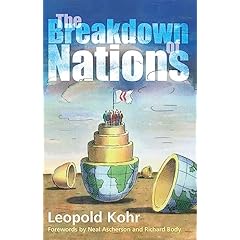 Published in 1957 by Austrian-born but great friend of Wales, and lecturer at the university in Aberystwyth Leopold Kohr (why isn't there a plaque to him on his Baker St home in the town?), this is a book before its time.
It puts Welsh independence (and interdependence) within the context of a Europe which has broken down the old 'nation' states. When one compares one of Kohr's maps with the current geo-political situation in Eastern Europe it's surprising how correct he was.
The good news is that the 'submerged' small nations of Western Europe are catching up. Despite the rather misleading title (it should read 'breakdown of 19th century nation-states') it's an intelligent but readable book. It demonstrates the intellectual and moral bankrupcy of the philosophy of the 'Big Nation' that the British nationalists of the Labour party hold so dear to their hearts.
Masaryk
More arrogance from Governor Hain
An independent Wales would "leave Wales isolated and irrelevant." - Wales and Northern Ireland Secretary, 'Governor' Peter Hain.
 Responding to the Wales on Sunday newspaper's opinion poll which showed an increase in support for independence, Peter Hain again displayed the insulting and bullying arrogance of his British Nationalist credentials.
Irrelevant? Why would an independent Wales be 'irrelevant'? Irrelevant to what? To Britain? To the world?
Every other independent nation is relevant to the international community. Why would Wales not be? Why do Peter Hain and his British nationalist stalwarts consider the Welsh as inferior, unequal and unfit to govern their own affairs?
Is Wales relevant now, as a sub-ordinate part of the United Kingdom? Where is Wales' prominence? Where is Wales' fair share of recognition, status and economic growth?
And if Wales were relevant now, why would she stop being relevant having gained independence?
Isolated? How could Wales possibly be any more isolated than any other independent nation? Is Denmark isolated? Is Ireland? Is Luxembourg? Is Finland? Lithuania? Latvia? Bulgaria, Canada, Mexico, Brazil, South Africa, India? Is Italy, France, America and indeed the United Kingdom, isolated?
So what does Hain mean by 'isolation'? Would England dig a trench the length of Offa's Dyke to keep us apart from the rest of this island? Would England impose economic sanctions - or even roll the tanks in? Would the EU make us the North Korea of Europe?
Come on, Peter Hain. If you don't support Welsh independence then at least treat Wales with respect. Award us the dignity of a mature and measured argument rather than this continuous conquistadorian nonsense. This simplistic, dissmissive, patronising patter is both insulting and nauseating, and reveals a superior imperialist attitude towards us inferior, notionless natives.
Who do you think you are? And what do you think we are?
 Responding to the Wales on Sunday newspaper's opinion poll which showed an increase in support for independence, Peter Hain again displayed the insulting and bullying arrogance of his British Nationalist credentials.
Irrelevant? Why would an independent Wales be 'irrelevant'? Irrelevant to what? To Britain? To the world?
Every other independent nation is relevant to the international community. Why would Wales not be? Why do Peter Hain and his British nationalist stalwarts consider the Welsh as inferior, unequal and unfit to govern their own affairs?
Is Wales relevant now, as a sub-ordinate part of the United Kingdom? Where is Wales' prominence? Where is Wales' fair share of recognition, status and economic growth?
And if Wales were relevant now, why would she stop being relevant having gained independence?
Isolated? How could Wales possibly be any more isolated than any other independent nation? Is Denmark isolated? Is Ireland? Is Luxembourg? Is Finland? Lithuania? Latvia? Bulgaria, Canada, Mexico, Brazil, South Africa, India? Is Italy, France, America and indeed the United Kingdom, isolated?
So what does Hain mean by 'isolation'? Would England dig a trench the length of Offa's Dyke to keep us apart from the rest of this island? Would England impose economic sanctions - or even roll the tanks in? Would the EU make us the North Korea of Europe?
Come on, Peter Hain. If you don't support Welsh independence then at least treat Wales with respect. Award us the dignity of a mature and measured argument rather than this continuous conquistadorian nonsense. This simplistic, dissmissive, patronising patter is both insulting and nauseating, and reveals a superior imperialist attitude towards us inferior, notionless natives.
Who do you think you are? And what do you think we are?
Wednesday 17 January 2007
English domination
Excellent letter by Gwyn Hopkins in the Western Mail today:
SIR As well as being shockingly misleading, Peter Hain's article (Western Mail, January 15) reveals grave deficiencies in our part-time Secretary of State's understanding of quantitative issues.
After discussing the prospect of only English MPs voting on English issues, he states, "The reality is that England would come to dominate the Government of Britain as a whole", as if this was not already emphatically the case. There are 529 English MPs out of a total of 646, so that 82% of MPs represent English constituencies. The governing Parliamentary Labour Party has 356 English MPs from a total of 425, ie 84% of its MPs are English. With "controlling interest" in any organisation being 51%, it is crystal clear that these overwhelming majorities already equate to complete English domination of the UK Parliament.
Mr Hain describes Wales as a "tiny nation". Aside from the derogatory connotations of the word "tiny" - such as insignificant and negligible - to which he obviously subscribes in relation to Wales, in worldwide terms he is very wide of the mark. Six of the 27 member states of the EU are tinier than Wales (population 2.9 million) and 32 of the 53 members of the British Commonwealth (60%) are smaller. Sixty-three of the 192 UN member states are tinier than Wales (33%), including some of generally high esteem such as Jamaica (2.8m), Cyprus (0.75m), Singapore (2.7m) and Kuwait (1.6m).
The contrast and inconsistency between the UK Parliament's determination and enthusiasm in defending the independence of Kuwait - half the size of Wales - in the first Gulf War and its (and Mr Hain's) tendency to ridicule the possibility of independence for Wales could hardly be starker.
GWYN HOPKINS
Cleviston Park, Llangennech, Llanelli
Subscribe to:
Posts (Atom)